

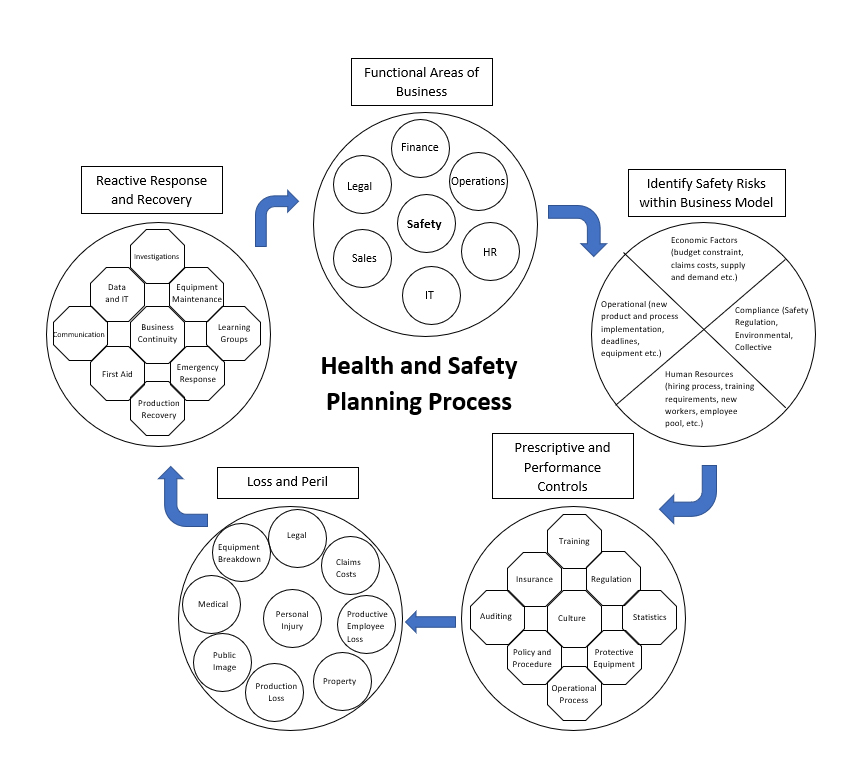
All business functions including Health and Safety love to utilize models to show process flow and implementation strategies. At Lacasse Safety Consulting we have developed a “model” to show how safety is just another functional area of a business and that a planning process can help integrate risk management, controls, identify loss, and effectively react to an event in your business.
The image looks confusing right? It doesn’t have to be. We try to use mind map imaging to ensure all the thoughts of your business are captured as it relates to safety.
To simplify you can look at it as: What do we do, what could go wrong, how do we prevent it, and when something does go wrong how do we recover from it?
Lacasse Safety Consulting’s model consists of five functional components.
1. Functional Areas of business
Determine what functions are associated with your business. Each organization is built differently some have robust marketing aspects, some concentrate their efforts on supply management and some focus on sales.
2. Identify Safety Risks within the Business Model
Probably the most important part of the Safety Planning Process is the identification of risks. (We will go into a risk-based series in a later blog stay tuned!)
If risks are identified a conscious decision can be made to remove the risk, reduce the risk, or ignore the risk and accept the outcomes if something is to go wrong.
Economics, Compliance, Human Resources, and Operational factors need to all be identified for each aspect of business function. As we do use this for safety specific measures we only identify components that interact with safety. Some examples may include:
Finance – Funds available to purchase protective equipment, training, statistical software etc.
HR – Hiring process available to ensure qualified candidates are hired, new worker onboarding protocols etc.
Operations – Maintenance schedule of equipment, procurement process for subcontractors
As you can see each aspect of business function contains “safety” components.
3. Prescriptive and Performance Controls
Implementing controls is where a collaborative approach is important to ensure risk is actually being reduced or removed. We look at both what has to be done (prescriptive) and what can we do (performance) to ensure the most successful approach to mitigation.
Prescriptive controls include: Regulation, Company Policies, and other legal requirements.
Performance based controls include: Additional training (leadership, communication, ethics), organizational culture, and utilization of statistical analysis
Just because there is risk present does not mean it always has to be addressed. Taking on risk is an aspect of business management and its important to identify the negative outcome (Loss or Peril) and positive outcome (Monetary or Performance) and determine the best decision for your organization. In Health and Safety, a highly regulated aspect of business you are more than likely going to want to achieve the lowest level of risk possible.
4. Loss and Peril
A result of not reducing or removing risk may be a loss or peril to your organization. Identifying what could happen influences the decisions we all make in regards to risk, and the amount we are willing to accept.
Loss includes legal ramifications, administrative penalties, property or equipment damage, personnel injury, among others.
Loss comes with drastically different severities and when loss does occur, because it always will (a debate for another blog) we want to ensure the severity is a low as possible.
5. Reactive Response and Recovery
In health and safety when an injury (type of loss) occurs many times blame is put on the worker or a piece of equipment, but this rarely is the cause of the loss.
An effective reaction to loss always begins with a review of the previous functional components of the planning process. What was missed? What risks were present in that exact time that the loss occurred? Are those risks always present, or was this a unique situation?
When reacting to loss a systematic approach with a group of individuals that perform the task or supervise the task will produce a more likely answer to why the loss occurred. Performing reviews in learning groups without the aspect of blame is collaborative and a more rewarding process.
If you would like to learn more about Lacasse Safety Consulting’s Planning Process, or require assistance in once specific aspect of the process please reach out via the contact page.
Lacasse Safety Consulting
Ryan Lacasse, CRSP